
Birdie every hole as the mindset. Scoring average as the reality. Top 25 is the outcome.

The Premise
Elite golfers don’t simply play shots. They organise their thinking around what they believe is possible, then make disciplined decisions that reflect reality. The T25 (Top 25) Scoring Framework is built on this balance. It holds an aspirational belief at the top end, while remaining grounded in how scoring actually unfolds over rounds, tournaments, and seasons.
The origin of this thinking came from my time working with VISION54, particularly their emphasis on belief, intent, and how players interpret outcomes. What follows is my practical scoring framework for competitive golf, shaped by that influence and refined through coaching players in real tournament environments.
At its core, this framework is about how players relate to scoring, and how they interpret outcomes emotionally as the round progresses.
The Belief: 54 Is Possible
The lowest possible score in golf is 54, birdie every hole. This isn’t an expectation or a demand. It’s a belief that acts as an orienting reference point.
Holding this belief doesn’t mean chasing it. It simply means allowing birdie to be available on every hole.
When players hold this belief, their attention shifts away from avoidance and towards opportunity. Instead of asking, “How do I avoid mistakes?”, they ask, “How do I create a genuine birdie opportunity?”.
Birdie intent isn’t entitlement. It’s orientation.
Birdie Intent Has Different Expressions

A key part of this framework is understanding that birdie intent doesn’t equal constant aggression. The intent remains consistent, but the way it’s expressed adapts to the hole, the conditions, and the player’s strengths e.g:
On a drivable par 4, birdie intent may mean being assertive off the tee, choosing a line or club that brings eagle or a simple pitch into play, while accepting that outcomes will vary.
On holes with accessible pin locations or favourable conditions, birdie intent may involve an assertive approach shot, recognising the opportunity rather than defaulting to safety.
On tighter or more demanding holes, birdie intent may mean playing sensibly from the tee, positioning the ball well, aiming to a general area of the green, and giving yourself a realistic birdie chance by holing a mid to long range putt.
The belief stays the same. The route to birdie adapts.
The Reality: Scoring Averages
While 54 provides the belief, scoring average is the reality that governs performance.
At T25 level, strong finishes aren’t built by the occasional low round. They’re built by regularly accessing the mid to low 60s.
A typical scoring distribution for a high performing T25 competitive player looks like this:
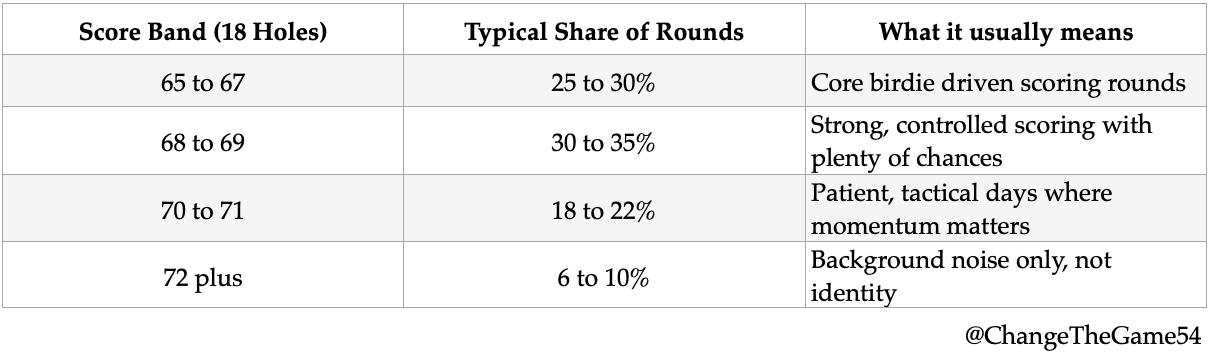
The key message here isn’t about the ceiling. It’s about the middle.
To consistently finish in T25, players must be producing rounds of 65 to 67 with real frequency. These aren’t special rounds. They’re the engine of competitive performance. Rounds of 68 to 69 support that engine, and the occasional higher score must be absorbed without emotional disruption.
If 65 to 67 feels rare, performance will feel volatile. If 65 to 67 feels normal, T25 becomes realistic.

Reframing Pars and Bogeys
Within this framework, par isn’t a missed opportunity. It’s often the correct score given position, conditions, or how the hole was meant to be played that day. Pars stabilise rounds and protect momentum.
Bogeys are where many rounds are mentally lost, not because of the score itself, but because of how it’s interpreted.
Most bogeys represent a small deviation from expectation rather than a breakdown in performance. When players emotionally label a bogey as failure, they often chase on the next hole. That chasing leads to bigger numbers.
Elite players keep bogeys in proportion.
Understanding Proportional Loss
Scoring isn’t binary. It’s distributed.
If the statistical scoring average on a hole is 4.25, then a score of 5 isn’t one full shot lost. It is 3/4 (0.75) of a shot relative to expectation.
When players understand this, their emotional response softens. The body stays calmer. The mind stays clearer; the next decision isn’t influenced by the previous hole.
This proportional view is essential for stable tournament scoring.

Fractional Bogies
This is where the concept of fractional bogies fits.
A fractional bogey is simply a bogey viewed through a proportional lens. It recognises that not all bogeys cost the same and that many are acceptable outcomes within a high level scoring framework.
A fractional bogey often follows:
A committed, assertive decision that narrowly missed
A smart recovery choice that removed double bogey from play
A hole where birdie intent was correct, but execution was slightly off
Crucially, a fractional bogey doesn’t change belief, strategy, or identity. The player immediately reorients to birdie intent on the next tee.
A Clear Outcome Hierarchy
Within the T25 framework, outcomes are interpreted as:
Birdie: Positive reinforcement of intent and execution.
Par: Neutral/Factual or positive. Maintains structure.
Bogey: A small, contained loss that preserves emotional control.
Double bogey or worse: Almost always the result of compounded decisions or emotional reaction, not the initial mistake.
This hierarchy protects momentum far more effectively than traditional score based thinking.

How the Framework Plays Out Hole by Hole
Begin each hole with birdie intent.
Choose the appropriate style of birdie for that hole (i.e. establish a “Baseline Play”).
Apply reality based on conditions, strengths and state.
Commit fully to the plan and each shot.
Interpret each outcome positively, neutrally or factually.
Reorient immediately to birdie intent on the next tee.
Belief remains constant. Expression adapts. Emotion stays stable.
Final Thoughts
The T25 Scoring Framework isn’t about forcing low scores. It’s about thinking and responding like a player who produces them consistently.
Believe in what’s possible. Select the right style of birdie for each hole. Respect scoring averages as reality. Keep outcomes in proportion. Protect emotional stability above all else.
When this happens, Top 25 finishes stop being chased and start emerging naturally as a by product of clarity,discipline, and intelligent intent.
Thanks for reading,
Oliver C. Morton
 Subscribe